The Glenbuchat Image Library
No: 2347 Contributor: Ken Cruickshank Year: 2021
3 Glenbucket Mutual Improvement Class 


Glenbucket Mutual Improvement Class meetings.
Click for Callam family introduction
Click for Callam essays
The mid years of the 19th century saw the emergence of new movement for self-improvement amongst working people of the towns, villages and country areas of the North East. Groups of likeminded men gathered together to form educational societies - mutual improvement societies, filling a gap in adult education and a need for recreation and entertainment. In general, their membership was made up of local working men - tradesmen, farm labourers, farmers, crofters etc. These classes were part of a nationwide movement which spread across the country, at a time of rapid social change, with the growth of the industrial cities and demand for reform of the old order.
Examples of the practical operation of this spirit in the nineteenth century included the Glen’s annual Highland Games and picnic, held in the Castle grounds; St Peter’s Fair, held at Kirkton; a Literary Society and a Mutual Improvement Society; and the Glenbucket Male and Female Friendly Society, set up to provide a small financial safety net for those members who fell on hard times (formed in 1822, a year before its more famous neighbour’s Lonach Highland and friendly Society, this Society was unusual in admitting female members). Glenbuchat was considered by many to be “the perfect glen”, and it was especially proud of its traditions of ballads, and of violin and bagpipe music. (The ballad tradition has received international recognition in 2007 with the publication of a scholarly edition of the local ballads collected in the 1840s by the Rev Robert Scott of Glenbuchat).
Early mutual improvement societies in Aberdeenshire were set up in Tough - The Tough Reading Society (1830) founded as an offshoot of the local parish library, and Rhynie - The Rhynie Literary and Debating Society (1833). But the movement really gathered momentum in the N. E. after1846, following the formation of the Rhynie Mutual Instruction Class. Reports of its success and activities spread by word of mouth and by extensive coverage of its proceedings in the newspapers (e g Aberdeen Press and Journal). The locality around Rhynie was a hot spot for new classes - Kennethmont, Lumsden, Leith Hall, Clatt, Duncanstone, and around Huntly - Kirkney, Gartly, Cairnie, Forgue, and up into the Cabrach, Glass and Dufftown, and Glenbuchat.
.
It was reported in 1849 'while three years earlier there was just one class (Rhynie) in the district, now there were eighteen or twenty, with a membership of about 400. (An Aberdeenshire Village Propaganda, Robert Harvey Smith. 1889)
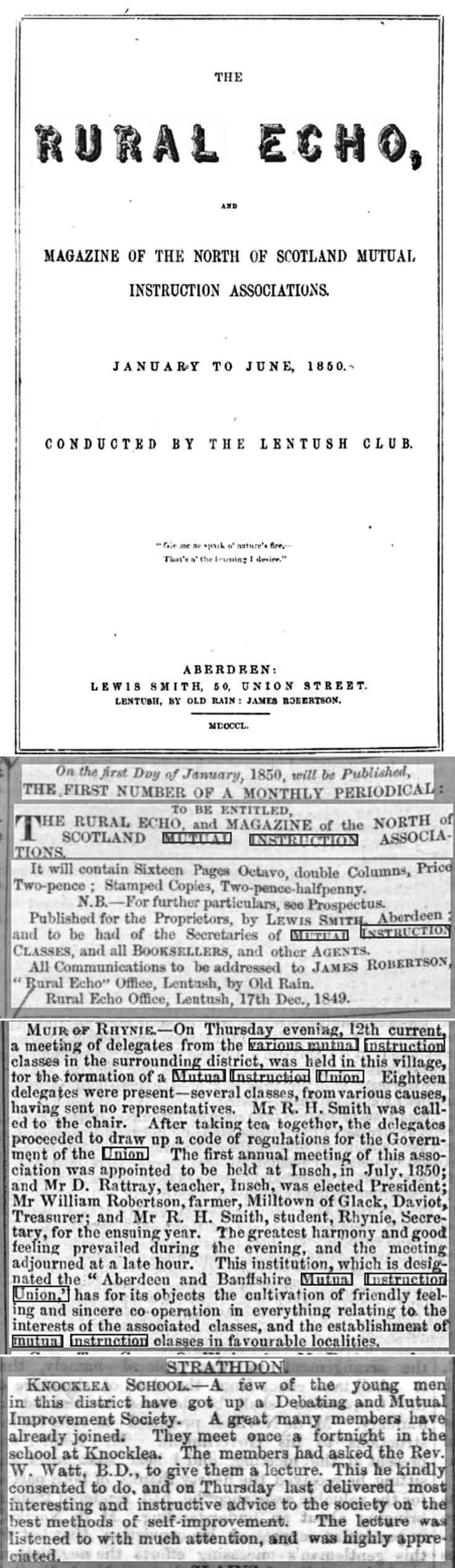
The Glenbucket Mutual Instruction Class was formed on the 31st March 1849 and by July of that year had joined with fourteen similar, independent societies to form The Aberdeen and Banffshire Mutual Instruction Union. (An Aberdeenshire Village Propaganda, Smith R. Harvey, 1889)
The Union's aim was 'The cultivation of friendly feeling and sincere co-operation in everything related to the interests of the associated classes and establishment of mutual instruction classes in favourable areas' (Aberdeen Press and Journal 18 7 1849). There was to be a mutual exchange of library books and a monthly magazine - The Rural Echo and Magazine of the North of Scotland Mutual Instruction Associations - published on the first of every month. (The Rural Echo, Jan - June 1850 - see Google books.) Besides being educational and entertaining, the magazine was to be a medium of communication between the widely scattered classes and members, and between the Union and the greater public.
The bland 'mission statement' of the Union probably reflected the difficulty it had in uniting the diverse, loose confederation of independent and autonomous mutual instruction classes. Each class reflected the aims and views of its founders and its local membership, setting its own tone. Some, seeing themselves for recreation and entertainment - as literary and debating societies, others as mutual instructional classes, with a strong educational mission. Some had close ties to the church with an educational and a moral improvement theme. Also part of temperance movement.
The Mutual Instruction Union was to be neither religious nor political, but an educational one, aiming to train its members to think, speak and act for themselves.
The larger classes, close to the towns, held public lectures with music and singing entertainment - choirs, soloists, charging admission.
Mutual instruction classes with an opportunity to enrol in courses of evening classes with the aim for its members of self-improvement through access to higher education, beyond he parish school, and progress to higher status jobs.
Many classes claimed membership had been the first step for a self-educated member ' by acquiring the habits of study and public speaking' to a high-status career in the professions, especially journalism, while others became active in growing trade unionism movement and in political. While not overtly religious or political, the membership (although unable to vote) in general, supported the Liberal Party and its views on social reform.
The Rhynie class and those of the district around, had strong links with the infant Free Church (formed in 1843). These classes, influenced by evangelical and reforming Free Kirk ministers, took on a campaigning role, for improvement in farm labourers working and living conditions. In particular the feeing system - itinerant work force of young single men.
The Free Kirks moral crusade against exploitative big farmers - the farm servants six monthly feeing system - blamed for the shocking illegitimacy rate in rural N E and other social ills.
A major complaint of the Union, which was centred around the towns and districts of Rhynie, Huntly and Alford (with a higher density of people, especially tradesmen) was that it was too localised to be of practical benefit to many of the newly instituted, widely dispersed, outlying classes of Aberdeenshire and Banff (less mutual assistance, exchange of lecturers, library books etc.).
The Union itself collapsed in 1857. The mutual improvement movement, however, thrived in the second half of the 19th and into the 20th century, with new classes formed while others folded.
In 1882 a few young men of Strathdon formed the Strathdon Mutual Improvement Association, which met once a fortnight at Knocklea School for lectures and debating (see cutting Aberdeen Press and Journal 13 5 1882). They also held social evenings, with lady guests, under the chairmanship of the established church minister the Rev Mr William Watt. With music - harmonium and violin, solo and trio singing and humerus readings and recitations (Aberdeen Press and Journal 10 10 1884). Again, it was probably short lived.
Nationally, the decline of the movement began around 1900, and like so many Victorian institutions, they largely passed away with the coming of the First World War.
No records of the Glenbuchat class are known to have survived, such as membership books, minute books etc.
It is not known how long the Glenbucket Class continued after 1851 - with its small membership - possibly non too long. A remote community, self-reliant, with little interaction with other classes.
But from records of the similar small, rural classes of the time, some of its activities can be deduced.
Members were called upon to prepare essays for presentation at the class meetings. Thereafter lively debates followed, and a vote on the proposal of the essay. Guest speakers were invited to give lectures (usually a local minister, teacher or doctor) on topics covering anything from scientific, literary, moral and social topics of the day. Social event afterwards.
All we have are a few bare statistics collected for the Union in 1851. A survey of the Glenbuchat class showed that since its formation in 1849, 30 members had joined, although two years later only 12 were then on the roll. Their occupations were classed as -
Mechanics (country tradesmen) 7
Agriculturalists 3
Various 2
A total of 45 essays had been presented to the class, and a library of 100 books established for loan to its members. (An Aberdeenshire Village Propaganda, Smith R. Harvey, 1889 A. U, L. - Special Collections)
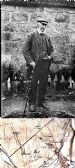
However, we do have three essays very probably written for presentation to the Glenbucket Class from one its members, John Callam, carpenter of Newton.
Click for Callam essays
Picture added on 20 February 2021 at 20:10
This picture is in the following groups
people
people
people