The Glenbuchat Image Library
No: 2457 Contributor: No Contributor Year: 2022
10 A Discarded Heritage. Article on Lime Kilns


The following article appeared in the Leopard Magazine in February 2003.
The Authors of the article are:
John Nisbet who was Professor of Education at Aberdeen University from 1963 to 1988. His interests included orienteering, golf, hill walking and even occasional rock climbing as well as amateur archaeology.
He owned a cottage at Upperton Glenbuchat from the 1940’s and clicking this link gives more details about it.
Ken Cruickshank who worked for the department of Agriculture and Forestry at Aberdeen University. For 20 years he had Rose cottage at Glenbuchat. Click for details and in the mid 1980’s produced two booklets of old photos of the Glen. He has also co-authored a book on the Lime Kilns of Donside. Click for details
Ken is also a regular contributor to this site.
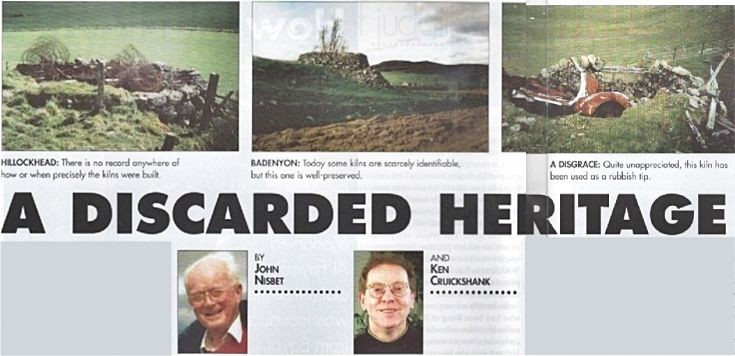
A DISCARDED HERITAGE
All around the North-East you will see abandoned lime kilns beside a track on the edge of a field. These kilns are part of our agricultural heritage, but they have been almost completely neglected. Nowadays, most of them are full of farm rubbish. old fence pout: and wires; there is even in one the rusty chassis of an old car. The fact that any of them have survived is a tribute to the skill of the original builders, and their present condition is a disgrace.
Almost all the kilns in Upper Donside are circular in structure. tapering towards the top, three metre: or more in height on the open side, but built into a bank so that the ground on the other side is level with the top. This allowed the lime and fuel to be fed in from above, and there was a large opening at the foot on the open side for raking out the burnt lime and ash. Sometimes there is an additional opening half-any up as a vent.
These round kilns are constructed without mortar like drystone dykes., and most are over 150 years old. A notable exception is a large kiln set ion a steep hillside in the upper reaches of Glen Ernan (Map reference NJ 304122)
There are lime kilns all over Britain, for we know that the Romans used them and in medieval times they were needed for the production of lime for mortar. With the coming of the agricultural revolution towards the end of the l8th century, the value of lime for improving the fertility of peaty soil was recognised, but until better roads were built from the 1830s on, lime was produced locally; in fact. in areas like Glenbuchat. it was produced on the edge of the fields where it was to be spread Then, as transport improved and enclosures resulted in larger farms, it became more economic to buy the lime commercially and the small kilns fell out of use, although some were still in remote areas well into the 20th century.
In other parts of the country, abandon kilns have been repaired and cleaned, and have descriptive plaques explaining their use and antiquity – one at Tomphubil near Pitlochry for example, is prominently featured on the Scottish tourist web site, www.scenicscotland.net/pitlovhry. The design of that kiln is square, with a straight wall on the open side, as in many other areas, for example, at Kilmartin in Argyll.
In our part of the country kilns take a distinctive round shape, and are so similar in construction that one could readily believe that they had been built by the one team of stonemasons. Each has three or four long granite blocks inside supporting the flue, and a very large stone supports the entrance. There is apparently no record anywhere of how or when precisely they were built
The Glenbuchat area is a particularly good one for giving insight into the history of these kilns. They are more frequent in the upper reaches of the glen, where the tenants of the estate were fortunate in having a ready supply of lime stone, quarried from and outcrop at Corrimore, close by the road at the pass at the top of the Glen before it crosses into Glen Nochty. The quarry is still there, but the lines of spoil heaps from hand-dug excavations nearby are obscured by forestry planting.
Just as important was the inexhaustible supply of hill peat as a fuel source, available at the peat moss to the west of Craig an Sgor towards the Cabrach. This moss was still in use by a few tenants up to the 1990’s and the lines of peat are still visible.
Parishes further down the Don valley such as Towie, Kildrummy and Monymusk had to buy their lime due to lack of limestone deposits or peat fuel, and there is evidence in the Duff papers in Aberdeen University Library’s Special Collection that the Laird, The Earl of Fife, tried to stop his tenants from illicitly exporting limestone from the Glenbuchat quarry, Instead, they distilled illicit whisky, but it is unlikely that they could have used the old kilns for that purpose.
In the course of the 19th century, the improvement of transport and the growth of commercial production of lime led to the abandonment of the old small local kilns. The building of the toll road from Aberdeen to Kildrummy and Strathdon, the canal to Inverurie, and finally die railway to Alford, opened up the whole area and clanged the pattern of life drastically.
The young men were drawn to leave the glen and seek their fortune in Glasgow or in the new dominions. We have the passenger manifest of the emigrant ship, the Earl Durham. sailing from Dundee and Aberdeen to New York in August 18 36. which includes the names of Alexander Ogg (aged 25), William Crawford (24) and Adam Hay (21), all farm labourers from Glenbucket (the old spelling). The glen which at one time supported a population of some 500 began to empty and, like the kilns, its farm cottages fell into ruins.
The well-known archaeologist, Douglas Simpson. who was librarian at King's College. Aberdeen. had a special affection for Glenbuchat. His history of the glen, ‘The Book of Glenbuchat’. was published in the 1940’s. Scanning the 1869 Ordnance Survey map of the area he identified 25 kilns in the glen. In 1949 A. D. Stephen made a count and could find only I5.
Today. some of these are barely identifiable except for the distinctive large granite lintel stones among a pile of boulders; but well-preserved examples are to be seen beside the road to Upperton (NJ 341190} and at Badenyon (NI 3-l1190). The old clachan at Upperton housed about a dozen families who farmed strips of land dawn the hill from the clachan to the river. These are marked on the 1869 map. Here, two further kilns in addition to the one beside the road can still be found: one by the burn at the edge of the fields to the north-east and the other in a field below the ruins of the clachan which is clearly visible from the road.
Over in Strathdon and in the upper reaches of the river by Corgarff, there are at least a dozen kilns in not too dilapidated condition, and Others can be found in the Pass of Ballater and on Braemar golf course. It is not just neglect and the passage of time which have caused the collapse and loss of these venerable constructions from a past age.
In the kiln at Badenyon, two rowan trees have taken root and have grown to a considerable height. They will in time cause the kiln to collapse, as has happened in several of the other kilns, such as the one at Ryntaing (NJ 202 338). Surely some action should be taken to preserve the best of our heritage, and to make them better known and understood as representing a mode of life long since passed.
Picture added on 18 October 2022 at 22:00
This picture is in the following groups
farm
farm
farm