The Glenbuchat Image Library
No: 2527 Contributor: No Contributor Year: 2023
145 A Week in Glen Gairn for a crofter's wife


A Week in Glen Gairn a century ago
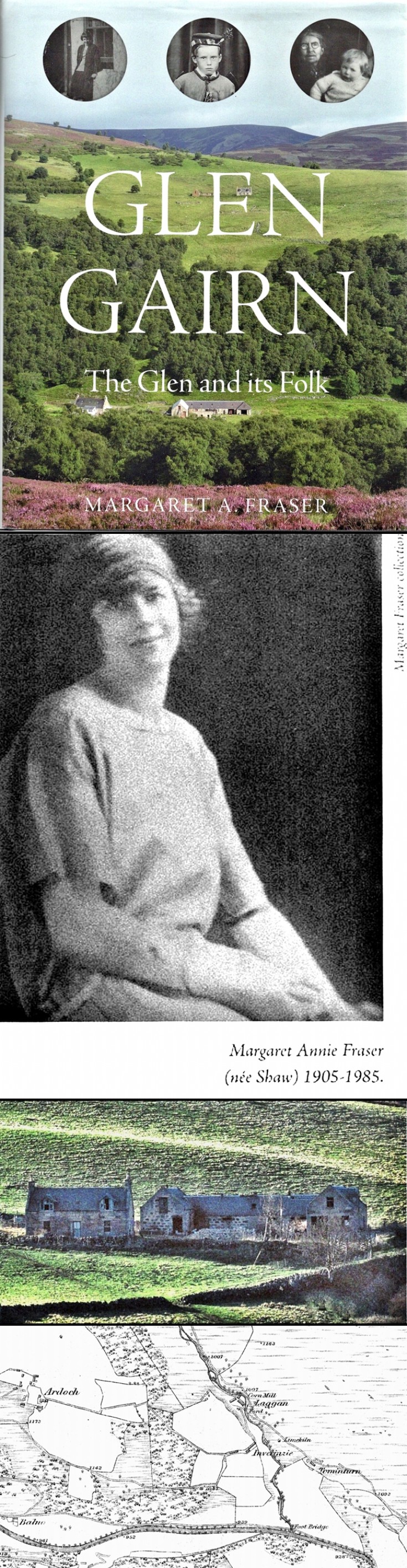
The pictures above show:
1. The cover of the book by Margaret Fazer ‘Glen Gairn, The Glen and its Folk
2. The author Margaret Fraser
3. Inverenzie the family farm after the family had moved out.
4. Map of Inverenzie (Inverinzie)
I am very grateful to the family of Margaret Fraser who published her book, for the pictures above and the text below.
Margaret Fraser (Nee Shaw) was born in Glen Gairn in 1905 and died in 1985.
She had a great interest in the Glen, its inhabitants its history and its way of life.
In 1978 she started to recorded her memories. In 2023 the family collected her writings and published them in a book, ‘Glen Gairn. The Glen and its Folk’
The book is an extensive account of the Glen and its people and way of life through the early 20th Century. It is now a way of life long gone but if you wish a detailed view of life at that time, this book provides it in detail. The book is published by Troubador Publishing.
Glen Gairn is about 12 miles from Strathdon and the following excerpt from the book highlights the work of a crofter’s wife which would have been reflected in many remote Glens of Aberdeenshire at the turn of the 19th century. I am sure similar activity would have been taking places in the crofts in Glenbuchat at that time
A Woman’s Work is never done
A review of the weekly work of a Crofter’s wife.
The lnverenzie house was a four-roomed house with scullery and milk house attached. Mother whitewashed the walls of the kitchen, scullery and milk house twice every year and it always looked fresh and clean. When I was a child there, the kitchen-cum-living room had these whitewashed walls and a cement floor which Mother always kept sparkling clean, a white wood scrubbed table and what we called a dresser, which was a kind of sideboard along the back of the room, and wooden chairs. On this dresser were gaily painted pottery bowls and plates with flowers, birds, etc., painted on them, also an old-fashioned tea caddy. The clock on the mantelpiece was left to my parents by Charlie McKenzie when he gave up the tenancy. I wonder where it is now. The window always had snowy lace curtains and the ledge was filled with flowers. I’ve been thinking of an old saying I heard my mother quote: “Man’s work is from sun to sun, but a woman’s work is never done". How true in these days.
This was the usual routine on Mondays. She rose around five to six o'clock and made the fee'd man's and her husband's and the girl's porridge. The two men came in at six o'clock, after they had fed the cattle and horse and sat down to porridge and milk, tea, oatcakes and cheese, bread and home—made butter and home- made jam. After they had finished, Mother swung the three-legged pot onto the crook hanging from the swey above the peat fire. It was filled with Fresh water which was boiled and another pot of porridge made for Robert and my breakfast before we left for school about eight o’clock. We had to eat our plate of oatmeal porridge every day, that and a cup of tea before we set out to walk the two and a half miles to school daily. Then immediately after we had left for school, the maid washed the dishes and cleaned the rooms, etc. Mother and her put fresh linen on the beds every Monday. It was either white cotton or linen sheets and pillowcases, not nylon in those days. Water was carried in from an outside spout that ran into the horse trough, two pailfuls at a time, and a clean ladle was set beside the pails on the scullery table for anyone who wanted a drink of water. The ladle was used to fill the cup. On Mondays, more water had to be carried in, and a huge pot, very much larger than the porridge pot, was filled and heated over the peat fire the same way. This was to do the huge weekly washing Mother did herself when the maid was cleaning up the rooms and filling the peat box with the day's peats, which was also a daily chore.
Mother washed clothes all day by hand from about ten o'clock when the water was warm until about two o’clock in the afternoon, pausing at about eleven thirty to make either a pot of potato soup or a pot of milk broth. This followed by tea and oatcakes was the washing-day — as Monday was called — dinner. The maid washed up and mother resumed the washing of the clothes. Sometimes, if the wash was bigger than usual, it might have been two thirty before it was all done and the tubs dried and laid past until next Monday. Then Mother washed herself, donned a clean dress and apron, did her hair and then took out a clean, sparkling white damask tablecloth, put it on the table and set the table with butter, jam, bread, oatcakes and cheese and fancy biscuits and covered the table with another damask cloth. She put the kettle on the crook above the fire to boil and waited until three o'clock, looking down the Gairn side or on the brae leading down to Pool Mary.
We would see Mrs Ross, Mrs Spence, Mrs Bowman or Mrs Gillanders coming down the brae on their way to visit Mother. They very seldom came on the same day. Then from the top side we'd have Mary Ann Hay from Ardoch, Mrs Cockie from Balno, Mrs Thow from Torbeg, Mrs Cameron from Dalfad, Mrs Duguid from Tomnavey and Mrs Smith from Reharchrie, Mrs Leslie from Braenaloin and Mrs Rettie from Delnabo and the Miss Ritchies when they were in the glen, and the minister and his wife and family made weekly visits. Each day, that table was set for visitors, and I'm pleased to say it was never set in vain. Some neighbour called about three thirty. Visiting time was recognised to be at that time. The length of the visit was about an hour. Tea was served and a boiled egg was usually served with it and the talk ranged around, say, how many cheeses each could make out of one bottle of cheese rennet, things like that. Mother went a little distance with her guests when they left. The maid cleaned the table and put away the clean cloth and at five o'clock, Mother began to make another pot of porridge
For the men coming in from their work and for us children who had arrived home from school about the time the guests left. At six o’clock, Father and the fee'd man, the maid and we children and Mother sat down at the scrubbed table and ate porridge and milk, oatcakes, home-made cheese, jam and bread and a big pot of tea. After supper, the dishes were washed up and after our school lessons were done, I had to sit and knit long black stockings. The maid and my mother did the same, so knitting needles clinked and stockings and socks were soon made. Father, the man and Robert started playing cards. Whist was the favourite game. Often, some other man came in for a game but if no one came they asked one of us, the maid, Mother or myself to take a hand, to make up four for whist. There was no radio or television in those days. Before I went to bed, I had to polish both my brother's and my own boots For school the following morning.
Tuesday was similar in every respect for Mother. Only this day it was ironing the lovely, clean, sweet-smelling clothes and all those lovely damask tablecloths which were used daily for guests coming in. Water had always to be carried in in pails for domestic purposes. Ironing was done by box iron as it was called. Tiles shaped like the iron were heated in the glowing peat fire and when red hot, were lifted by tongs and inserted into a door at the back of the iron. When it had cooled, another was in the peat ready for changing with the cold one. This was again a hard job, standing ironing for hours. There was stopping at eleven o'clock to make dinner, maybe stoved potatoes (tatties) or some days it was tattie soup, very seldom butcher meat, although on a Sunday we had a hen, not roasted but boiled in soup. The ironing was laid past in their places. A drawer was for sheets and bed linen, another was full of the damask tablecloths and each had a drawer to keep their own clothes. The fee’d man got his clean, ironed clothes from Mother and took them out to his iris: (box, kind of trunk). After the ironing was finished, the same procedure was carried out as on Monday, but it would be a different guest.
Wednesday morning was similar to Monday, rising around five o’clock, and the breakfast never varied, but today Mother's task was making oatcakes. She had huge tins which she filled weekly with the following weeks supply of oatcakes. I can see her in my memory standing at the clean scrubbed table, clad in a spotless white apron, mixing oatmeal and a pinch of salt and bicarbonate of soda together, making it into a paste with either whey or clean tepid water in a bowl, taking it out in a ball onto a baking board, patting and rolling it into a thin round circle, then cutting it into four quarters, which she rubbed over with dry oatmeal and transferred onto a girdle. [Griddle is the present-day name for it.) She had the girdle on the swey above the peat fire. When one side of each quarter was cooked, she turned them deftly by hand and cooked the other side. She then had a brander-like thing called a toaster, so after the oatcakes were cooked, she took them off the girdle and stood them on this toaster and toasted them until both sides were crisp. Her oatcakes were a treat to eat.
You can imagine the time and hard work it entailed, standing for hours making a week’s supply for six people, not including the visitors. Again, the same after her baking was done, they stood on the dresser and cooled and were then packed closely into the big tins. The routine was then the same as the previous days. She was ready to welcome her guests at three thirty. Thursday mornings routine was the same as the previous days, up at five for breakfast, and I forgot to say that the cows had to be milked every day and calves Fed after Mother had her own breakfast, then after she had had her dinner and at night again before she went to bed. It was scone baking day on Thursdays. White flour scones, baked on the girdle, and crumpets or pancakes as we called them, a great treat eaten hot with a drink of milk. These were wrapped in clean linen towels to keep them fresh, as there was no fridge then.
Friday was mending day and similar to all the other days: guests at three thirty and finishing the day similar to all the others. Another chore I didn't mention was filling about seven lamps with paraffin and filling two or three byre lanterns too; the maid did this. All the lamps had glass chimney sort of covers over the naked flame. One lit a wick, a sort of canvas strip, which Fed the lamp with the paraffin, and the lamp glasses kept wind and draughts from the flame, which gave out the light. All these glasses had to be cleaned and polished daily. Now Saturday, the day we children were free from school. The house got a big clean—up this day. The floors of every room were washed and polished, the bedroom floors were covered with linoleum, so all got both washed and polished with home-made polish, made from bee’s wax and turpentine. No guests were to tea on Saturday. My job was to clean every spoon in the house with Brasso, and the knives I cleaned on a board covered with moleskin. Bathback was sprinkled on the moleskin and I had to rub and rub the knives backwards and forwards until the knife blades gleamed. I'd also to black lead the fenders which were in front of the grate and black lead a thing at the door that people cleaned their boots on before coming into the house.
Sunday was called the day of rest, so we got a wee while longer in bed, but not much longer, as horse and cows had still to be fed and milked. Usually, ‘Willie Gillanders, the farmer from Lary, paid a call on Sunday forenoon, and Father and he enjoyed a chat and a cup of tea together. He usually stayed about an hour then went home. Father then put on his white shirt and black suit and we children had to dress and go to church with him. We took one hour to walk to church and the service was at twelve and lasted an hour, then we came home to dinner of hen broth and tatties.
Then the animals were fed; no other work was ever done on Sundays. Supper on Sunday was a boiled egg, oatcakes, butter and home-made cheese. Butter was usually made on a Friday with a plump churn. One stood and worked the handle up and down in this circular churn, hence the name plump. These churns are antique today but they produced lovely butter and the buttermilk was kept for baking scones, as the scones were much lighter when the dough was made with buttermilk instead of ordinary milk. Now by this you can see how true the saying "Women’s work is never done" was then.
Another visitor who came annually, maybe not a visitor in a sense, was a man from Buckie who came selling jewellery, watches, clocks, etc. His name was F.F. Angler and he was a German man. After World War I started, he never came round again. Being a German, he had always to report his whereabouts to the authorities. He came in a horse-drawn vehicle and must have taken in many places to show his goods between Buckie and Glen Gairn. He never went further up the glen than the Hays’ at Ardoch. So well I remember him bringing in boxes and cases of jewellery and spreading them over the big kitchen table. They made a wonderful display; rings, bangles, watches and watch chains, clocks, Alberts for gents’ watch chains, cuff links, tie pins, etc. I loved to watch this display. We all gathered round the table. The fee’d man was called to see and purchase anything he fancied. The maid, Father and Mother and we two children all gathered round the table to feast our eyes on the wonderful gems, F.F. Angler telling the price of each article. I remember my mother buying a lovely gold watch and a gold chain to wear the watch on.
I have the chain today but I never knew what happened to the watch. At that time, ladies wore their watches suspended from their necks on a chain and into a pocket in their blouses. My father also bought a gold watch and chain which he left to his grandson, also a William Shaw, named after Father. On my father's death, I found my great-grandfather's gold albert with a large cairngorm seal on it with the letters WS. on it, as he was Willian Shaw too and he had used the seal for sealing his letters. So, I gave it to my nephew William Shaw as I considered it a family heirloom and I hoped another William Shaw might fall heir to it some day in the future. That watch my father got was lost a few days after he purchased it. It was at harvest time and all the sheaves had to be lifted and bound and stoked by hand. Father had been bending down and lifting a sheaf and the watch hadn't been on the chain so it had fallen out of his pocket. How well I remember that night; it was brilliant moonlight and we went round each stook and listened to see if we could hear the watch ticking, and sure enough it was heard and the sheaf it was bound into opened and the watch was found unharmed. If we hadn’t listened before the watch ran out, it would have gone through the threshing mill and been completely destroyed as Rev.]. R. Allan's father's watch was at Dalfad.
Another travelling salesman I remember was from a city store in Aberdeen, Mr Rae who sold suits, vests, long pants and strong material for making working shirts. It was usually a nice blue with either red or white stripes. He took orders for suits and shirts and measured the menfolk for these articles. Mother never ordered made shirts but bought the material. After I was old enough to sew, I shaped and hand sewed every shirt my father wore, and when the sleeves wore out at the elbows and wrists, I put in new sleeves and gave them another lease of life. Father bought me a second-hand sewing machine when I was eighteen but up to then I sewed everything by hand.
One other happy childhood memory is my brother and I walking through the plantation at the back of Laggan. This plantation was cut down nearly thirty years ago, but Robert and I found great pleasure in it looking for birds’ nests in the springtime. Wood pigeons were numerous and I remember once we found an owl’s nest at the fork of a tree, which was quite a thrill. Another recollection is going to a party in the farm cart drawn by Prince, our black Clydesdale horse, driven by my father. Mr Keiller, our laird, gave a Christmas party at Craigendarroch For the children of his employees and tenants, and Robert and I were invited. Fathers cart was full of children: four Camerons and Annie Cockie, Robert and myself. It was a Frosty night and the cart had iron shop wheels as all carts had then, and I remember the ringing sounds these wheels made on the hard, frosty road, stars twinkling in the night sky. In spite of it being very cold on the homeward journey, sitting in an open cart, it was a lot of happy, excited children that Father drove home that night. I got a lovely book off the Christmas tree; it was Alice in Wonderland. Mrs Spence, one of Mr Keiller's workmen's mothers, got a lovely gift. I thought it was beautiful. It was a tiny cottage, actually a weather vane. A woman with a parasol came out of the door if it was to be sunny weather, but if it was to be wet or cold, the gentleman came out clad in a coat.
I spoke of the travelling Folk when I mentioned Mothers guests, but I don’t think anyone today could have any idea of the number of these people that called every day. Some were selling ribbons, needles, thread and buttons, laces, combs, etc. Others had hard fish or brooms and pot scrubbers, both made out of heather, all begging For Food. Many had a horse and cart and usually a dog. and the cart was full of bairns. 'They came down the brae from Lary on to Laggan Cottage, and all said they were going to Tomintoul. Dozens of children were brought up just by walking the glens begging and camping wherever they stopped for the night, or they got shelter in someone’s barn. The women always had a baby on their back wrapped in a shawl or dirty old plaid. Every day, Mother gave many’ pieces to the weans’ they asked, and also oatmeal begged for in the words, ‘Please give me a puckle of meal for the weans’ porridge." They never went away empty-handed. Tea and milk and old books were begged for too. How their bairns survived the rigours of winter I don’t know. The Mr McKenzie sisters kept beds in the two sheds they had. If too many travellers came in one day, the most deserving ones with little children had a bed for the night in these sheds; they housed as many people as possible.
Picture added on 06 June 2023 at 21:48
This picture is in the following groups
farm
farm
farm



Ed
The book is available on Amazon and I'm sure other good bookshops