The Glenbuchat Image Library
No: 2601 Contributor: No Contributor Year: 2013
160 Gill Russell's 'Pulpit'


The Glenbuchat ‘Pulpit’
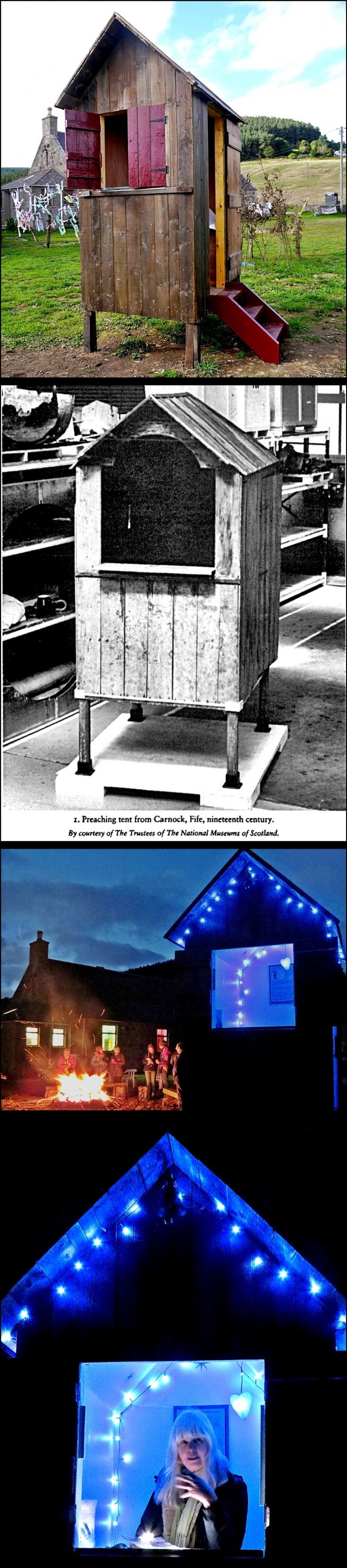
In 2013 a ‘pulpit’ was erected by Gill Russel and Chris Tauber as part of Gill’s Landmark Artistic residence at Glenbuchat Hall, Strathdon.
The picture above shows:
1 Gill Russell’s ‘Pulpit’
2 An original ‘Preaching tent’
3 The 2013 Pulpit Party
4 Gill Russell having a rant!
Gill Russel makes the following comments.
“The Pulpit makes reference to our religious culture that was so much more central to people’s lives than it is today. It also explores the juxtaposition and balance of internal and external issues, broadcasting, reflection, projection and assimilation.
In the context of the surrounding landscape of Glenbuchat, Pulpit is a reflective space to contemplate memory, identity, roots and connections.
The Pulpit is situated outside Glenbuchat Hall facing Ben Newe. The audio soundtrack lists the names of the houses in the glen, spoken by voices of the people living in them. Thoughts, memories and reflections can be written in the ‘Book of Glenbuchat’.
The Pulpit is based on the wooden ‘Preaching Tents’ that were used as temporary pulpits for open-air services. In the period before the 19th century such tents were common, not least after the Disruption of 1843 when many Congregations broke away from the Established Church to form the Free Church of Scotland. At first, at this time of religious zeal, many congregations were church-less, hence the use of these portable ‘preaching tents’.
A Pulpit party was held Nov 2013 with bonfire, food and wine. Participants were invited to enter the pulpit to declaim for up to three minutes on topics of their choice. This included poetry, views on land management, thoughts on the nature of art, rants about over use of acronyms, cynicism in society, and many more. The declamations were a healthy mix of reflections and ranting, helped greatly by whisky. The Pulpit finally became the artwork it was intended to be that night!
The Pulpit was built by Chris Tauber in Aug 2013. It was funded by Aberdeenshire council as part of Gill's Landmarks residency in Glenbuchat, Strathdon.”
Preaching tents
The Pulpit above relates to preaching tents which were erected for Church ministers as they preached in the open air until the Churches were built. This became common after the Disruption of 1843 when the Free Church broke away from the Established Church of Scotland. The ‘Tents’ could have been fabric but as often as not they were simple wooden structures which protected the preacher but not the congregation.
The following is an article on Preaching Tents
https://regionalfurnituresociety.org/wp-content/uploads/2017/01/preaching-tents-david-jones.pdf
PREACHING TENTS
David Jones
Scottish Kirk Session records occasionally contain interesting details about the making of outdoor pulpits. Only a handful of these pulpits are known to exist, but since they were important items in the repertoire of country wrights and because they are known to have appeared in Scottish communities abroad, notably in Ulster and the United States of America, it is worth investigating their history.
A typical mention of a ‘preaching tent’, is as follows: ‘Mr Jack agreed with Robert Scott, wright, for making a tent for the benefit of the work of the Sacrament without Doors’.
This extract from the Kirk Session records of St Mary’s, Biggar, notes the making of a tent for the celebration of Communion outdoors on 21 and 22 July 1734. The tent that Robert Scott made does not survive, but it is likely to have been a wooden structure similar to that illustrate. This form, with pitched roof, front opening with bible shelf, and short legs to raise it from the ground, is consistent with that seen in most eighteenth century prints of the subject and tallies with the numerous picturesque descriptions left by foreign travellers in Scotland. Daniel Defoe, Robert Southe3 and Dorothy Wordsworth, for instance, each recorded a first encounter with a preaching tent of this type. Representative of such visitors’ descriptions is the following account made by Thomas Thornton in c. 1786. A few miles north of Lauder, the author was: 'not a little surprised to find my progress stopped by a number of people, crowded together to hear a parson, who occasionally peeped out of a sentry box. Enquiring what could be his intentions, I found it was a parson preaching to a half-drowned audience. As I was not, however, of the Kirk of Scotland, I drove on, somewhat astonished that the auditors could not be contented with hearing that gentleman’s tenets delivered regularly once a week.
The holding of outdoor Communion and attendant sermons was not a weekly but an annual event. In Biggar, for instance, it was not observed even yearly and when held it was regarded as an occasion for the whole district. Several local ministers would take a share in the services and the event would take place one year in Biggar, another year in Culter and another at Symington. These Sacramental occasions happened all over Scotland and were not restricted to Highland, Island, or Lowland regions. The origin of regular outdoor Communion seems to be of post-Reformation date, perhaps reflecting a desire to keep holding open air religious festivals when these had all but stopped after 1560, but the practice certainly enjoyed a marked growth in popularity in the 1670s and 80s following the restoration of episcopacy by Charles II and James VII and II. In this latter case use of the preaching tent was a direct response to imposed religious settlement, but during the eighteenth century it became very firmly connected with Church secession.
Tents were used by breakaway groups in the two splits against Patronage in in 1733 and 1761, and during the nineteenth century, at the Disruption of 1843, when ministers and their congregations left the established Church of Scotland to form The Free Church of Scotland. They were used later at the division of the Free Church in 1892, when the Free Presbyterian Church was formed. Since then, following the 1989 disciplining of Lord Mackay for attending the Roman Catholic funeral of a colleague, the Free Presbyterian Church has divided. Members of the new Associated Presbyterian Church with sections in both Scotland and Canada, now use worshipping space in the churches of other, host denominations. It is almost certain however, that the use of preaching tents died out after the Free Presbyterian Church had built their own new places of worship following the last split, in 1892. In some remote parishes these were not built until the 1920s and churches still have tents which were used in the early years of the twentieth century. The tent then, occupies a very firm place in the material culture of Scotland and rarely can a piece of outdoor furniture have been the focus of so much attention. Whether used for congregations which overflowed existing church buildings, or by itself at a ‘preaching station’, the tent was always at the centre of a large crowd.
Picture added on 31 October 2024 at 21:35
This picture is in the following groups
hall
hall
hall