The Glenbuchat Image Library
No: 2617 Contributor: No Contributor Year: 2025
172 Glenbuchat Mill Atrefacts 4


Glenbuchat Mill Artefacts 4
In 2025 the Mill of Glenbuchat was being restored. In the process of clearing the site a number of artifacts were found.
Click for the first page of Mill artifacts
Click for the second page of Mill artefacts
Click for the third page of Mill artefacts.
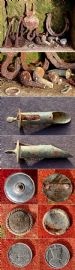
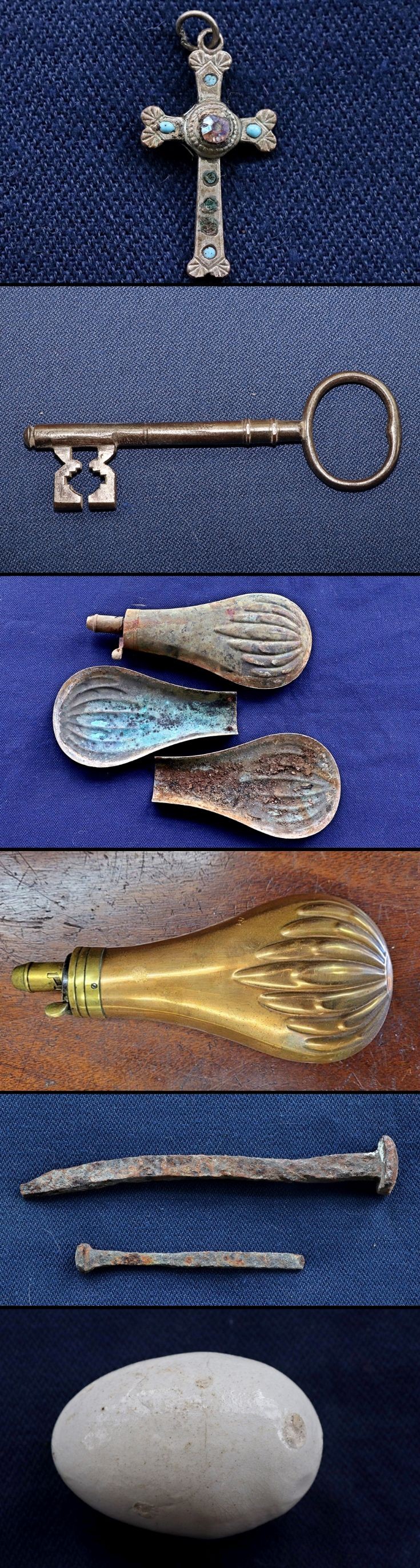
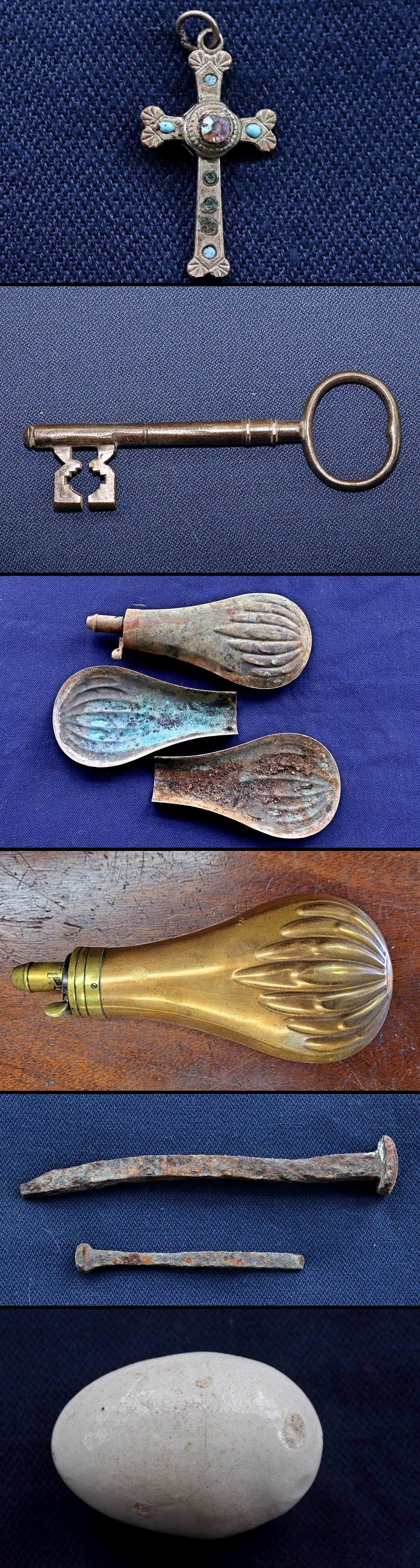
The above photos show:
1 A small crucifix inlayed with blue stones ?opal. and probably glass.
2 A original key for the Mill
3 & 4: Two Powder flasks, one complete the other in two halves. The second picture from the web showing how the flask would have looked
5 2 handmade nails
6 A ceramic egg
The Crucifix
There is no record about whom may have owned the crucifix.
Key
The key was for the large doors opening into the Mill
Powder Flasks (details from the Internet, various pages)
The picture from the web shows a clean Georgian copper and brass pear-shaped gunpowder shot flask.
Powder flasks are small, portable containers designed to hold gunpowder. From the 1400s to the 1800s, powder flasks were indispensable for charging and priming firearms of all types.
The measured quantity of powder was drawn off by using the spring-loaded pivoting cap on the nozzle.
Firearms became more and more sophisticated during the 16th-century but still required a number of accessories to load and operate them. The main charge, placed in the barrel with the shot, was carried in the powder flask. Smaller priming flasks contained fine-grain powder for priming the pans of wheel-lock firearms. Flasks were attached to a bandolier, a type of sling worn over the shoulder or around the waist, from which hung the various accessories required for a weapon including spanners for the mechanism, measured charges, powder flasks and priming flasks.
For Muzzle loaders
In general, the sequence of loading is to put in first gunpowder, by pouring in a measured amount of loose powder, historically mostly by using a powder flask (or powder horn), or by inserting a pre-measured bag or paper packet of gunpowder (called a cartridge) or by inserting solid propellant pellets. The gunpowder used is typically black powder or black powder substitutes like Pyrodex. Sometimes two types of gunpowder (and two flasks) were used consisting of finer priming powder for the flash pan and coarser powder for the main charge behind the ball. This was particularly the case with earlier muzzleloaders like matchlocks but appear to have been less common with flintlocks and was irrelevant with percussion locks since they used percussion caps rather than priming powder.
Handmade nails
Hand-made nails, forged by blacksmiths or ‘nailors’, have a long history dating back to ancient times, with evidence of their use found in ancient Egypt and the Bronze Age. In the UK, they were extensively used in Roman construction. Up until the 1800s, nails were predominantly made by hand, with the process involving heating iron rods, shaping them into points, and forming heads. The surname Naylor often denotes a family lineage involved in nail making.
Nails, or nail-like fasteners, have been found dating back to ancient Egypt and the Bronze Age, with some examples made from bronze. The Romans used nails extensively in construction, as evidenced by the large quantities found in Roman fortresses, such as the one in Inchtuthil, Perthshire. During the Tudor period, nails continued to be handmade, typically with a square shank, and were often used in housing construction.
While the first nail-making machine appeared around 1600, hand-made nails were still prevalent until the late 18th and early 19th centuries. Blacksmiths would heat iron rods, shape them into points, and then create the nail head by hammering the softened end. Early nails were made from bronze or wrought iron. Hand-made nails initially had a square or peg-shaped head, later evolving into the rosehead design.
The introduction of cut nails and wire nails, produced by machines, gradually replaced hand-made nails in the 19th century.
Ceramic egg
Ceramic Hens Eggs. You can encourage hens to lay eggs in the nesting boxes, rather than on the floor or anywhere else, by putting the ceramic eggs in the nesting box. Ceramic eggs can also help prevent chickens from eating eggs and pecking their shells, as the ceramic shells are much harder and discourage this behaviour as a result. Finally, ceramic eggs can encourage broody behaviour in hens.
 View Large Version
Picture added on 07 July 2025 at 21:29
This picture is in the following groups
mill
mill
mill