The Glenbuchat Image Library
No: 2571 Contributor: No Contributor Year: 2024
28 Chinese Gaming Box and Tokens c 1760


Chinese Gaming Box and Tokens
If a larger view required click on the ‘view large version’ link at the bottom of the page.
Click to see the album of Treasures of Castle Newe
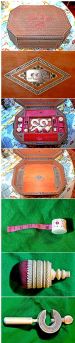
The pictures above show:
1 Box with intricate Chinese images on it thought to be a Chinese Gaming Box
2 With the lid removed there are 9 separate compartments again with intricate Chinese images.
3 - 7 Inside it contains what initially just seemed on the photo to be pieces of paper, are in fact mother of pearl Chinese Gaming Tokens. See below for details.
The depictions of "billing birds," which portray two birds touching or clasping each other's bills dates the tokens circa 1750-1780. This would suggest that the box was purchased by John Forbes ‘Bombay Jock’ while he was in Bombay. Forbes & co traded in India but also had ships which traded with China and the box may have come back on one of those trips
Chinese Gaming Boxes
Between 1785 and 1810, sets also included oval and shuttle shapes. Complete sets of gaming counters were often housed in lacquered boxes, which contained several smaller boxes, some to house gaming counters and others to hold decks of cards. Many boxes also had trays painted with court cards.
About Chinese Gaming Counters
From: https://archives.yale.edu/repositories/11/resources/827
Mother of pearl gaming counters were handcrafted by artisans in China from circa 1700 to circa 1840, for use in scoring and bidding in card games in the Western world. They were chiefly created for trade with Great Britain and, to a lesser extent, with other European countries and the United States. The gaming counters were fashioned from the nacre of large oyster shells, which imparted a metallic silvery sheen and a flat even finish to each counter. They range in shape, usually circles and parallelograms, as well as in size, usually from 26 millimetres to 35 millimetres in length and width. The gaming counters are usually inscribed with a coat of arms, crest, or monogram of a family or individual, as well as other visual decoration.
The production of mother of pearl gaming counters coincided with increased trade between the Western world and China. At that time, Western society had a fashion for playing card games, including Ombre, Quadrille and Pope Joan, which required counters for scoring. The trade in mother of pearl gaming counters continued until around 1840, when whist, which requires a different scoring method, became the most popular card game in the Western world. The production of counters gradually ceased around 1840.
Overall, gaming counters are divided into two categories: bespoke (made-to-order) counters, with the coat of arms, crest, or monogram of a family or individual; and ready-made counters. Around 1760, it became fashionable for counters to have monograms even without a crest or coat. Many of the bespoke sets accompanied orders for armorial porcelain services. Ready-made counters were also available with blank roundels for later inscription in the Western world or with non-specific heraldic representations.
Sets of counters during the first decades of the eighteenth century did not have fixed combinations of shapes or sizes to comprise a complete suite. Some of the earliest counter sets, from circa 1720 to circa 1760, include fish-shaped counters, while double fishes were produced from circa 1720 to 1730. By 1750, most sets included 140 counters in three shapes: round (20 counters), short-oblong rectangle (40 counters), and long-oblong rectangle (80 counters). Between 1785 and 1810, sets also included oval and shuttle shapes. Complete sets of gaming counters were often housed in lacquered boxes, which contained several smaller boxes, some to house gaming counters and others to hold decks of cards. Many boxes also had trays painted with court cards.
Decorative elements, borders, and edges on gaming counters can be used to date them. What follows are brief timelines for each. For further information about mother of pearl gaming counters, see Bill Neal, Chinese Mother of Pearl Gaming Counters ([Great Britain]: Chezbill, 2007).
 View Large Version
Picture added on 12 February 2024 at 18:58
This picture is in the following groups
castle
castle
castle