The Glenbuchat Image Library
No: 2524 Contributor: No Contributor Year: 2023
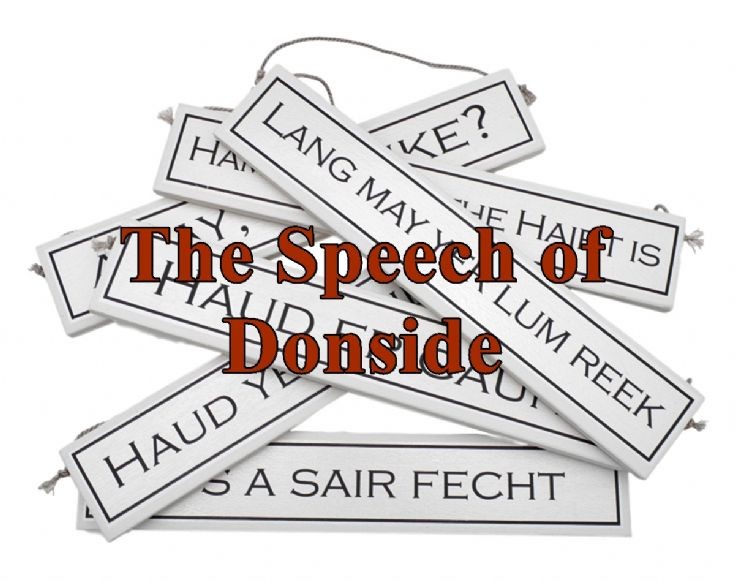
27 The Speech of Donside


The Speech of Donside
The following article is reprinted from and 1988 booklet, Upper Donside, Reflections on the Place and People.
The article on The Speech of Donside was written by the late David Murison.
(If there is any objection to the reproduction of this article, please email the editor using the email address on the introductory page.)
What is interesting is that the author does not use the name Doric for the North East language. The derivation of the name ‘Doric’ is added to the end of the article.
The Speech of Donside
by David Murison.
It is rather idle to speculate on the first language of West Aberdeenshire as we know nothing of it. We have to wait till the Iron Age and the Christian era before we come on the first relics of speech in the region. These are engraved on monoliths, chiefly the so-called “symbol stones”, which pepper the north- east of Scotland, though only a few have actually inscriptions on them. Unfortunately, the alphabet in which they are engraved, called Ogham, is not always easy to transliterate and still less to understand. Amid much dispute the predominating theory is that the inscriptions appear to be epitaphs and consist chiefly of personal names, that the language is akin to, if not actually a dialect of, the Celtic speech spoken throughout Britain in the early centuries A.D. of which the modem survivor is Welsh and to which the name Pictish has been given. It was noticed that many place-names began with Pit- and Aber- (as in Wales), which have in consequence been considered to be Pictish words. Pit- in fact goes back beyond British to the early speech of Celtic Gaul where the root word petia is found meaning a piece of land, a settlement, from which is derived the word ‘piece’, and possibly also ‘peat’, a piece of turf.
With the Picts we are into historical times and the subsequent course of events is easy enough to trace. The Scots from Ireland, who spoke another Celtic dialect, still surviving as Gaelic, amalgamated with the Picts in the middle of the ninth century to form the kingdom of Alba or Scotland. The Pictish language was submerged and replaced by Gaelic, a fact re- flected as regards place-names in the adoption of the Pit-element to which a Gaelic element might be suffixed, as e.g. Pitsligo, where Pit- is originally Pictish and -sligo is Gaelic. So in our area under consideration we have Pittenteach in Auchindoir, Pittendreich at Keig, Pitandlich at Towie; no Abers however. As for the rest of the place-names, they are in the main of Gaelic origin, Strathdon, Lonach, Glenbuchat, Towie, Kildrummy, Collievar, Brux, Auchindoir and dozens more, all showing that the area was originally and pretty extensively settled by Gaelic speakers, and that means in general terms before the thirteenth century, because in that century a new linguistic situation was beginning to develop in the north-east of Scotland. The Normans brought from England their domestics and stewards to assist them in the management of their new estates, all of them speaking the amalgam of French and Anglo-Saxon that we now call English. A further complication was the injection of Old Norse by the Scandinavian Vikings. When finally in the thirteenth century this hotch-potch begins to sort itself out it divides into a northern and a southern branch. The northern dialect became the speech of the kingdom of Scotland.
It had reached Aberdeenshire by the middle of the twelfth century and by the fourteenth it was the language of government, law, commerce and literature and of an ever-increasing number of the inhabitants of town and county alike, especially in the lower reaches of the shire, encroaching more and more on the hinterlands, where Gaelic held out until the nineteenth. In 1795 in the first Statistical Account, we learn that Gaelic was spoken only above Corgarff and over in Kirkmichael in Banffshire; while about half the folk spoke it, it was well laced with Scots and English and all the younger folk were already bilingual. Further down the Don, Kildrummy spoke Scots only, “with the enunciation peculiar to the county of Aberdeen”, while in Auchindoir “the only language spoken here is that dialect of English which is common in Aberdeenshire. The peculiarities of it a native is perhaps little qualified for pointing out. The people in the south of Scotland say that the tone is hard and to them has the appearance of passion and bad humour”. One dialect tends to deride another as uncouth but fortunately we are not called upon to discuss the passion and bad humour of the people of Auchindoir.
With this rather discouraging critique of our speech, it is time to look at it in more detail. Dialects differ from one another in their sounds. their grammar and their vocabulary, each in varying degrees. Even within the limits of West Aberdeenshire there are slight differences as between one district and another which only a native ear is so finely attuned to spot and it is astonishing how quick this sense can be. Natives, will tell you how the pronunciation of words like kye and whey change round about Lumsden on the watershed between Don and Bogie and the speech intonation alters in ways which cannot be represented in print. So Scots is distinct from English largely in its vowels, less so in its consonants, not much in its grammar, but markedly in its vocabulary, as the ten volumes of the Scottish National Dictionary amply attest.
In comparing the vowel systems of Scots and English, the simplest way is to begin with the long vowels a, o, u in their common ancestor, Anglo-Saxon, and following their diverging developments in the north and south over the centuries. Long a in Anglo-Saxon (the sound ah) came to be sounded oh in southern English but eh in the north in the fourteenth century, and hence Anglo-Saxon sar becomes English sore, Scots sair, ta becomes toe, tae. Other examples are mair more, home home, stane stone, wrait wrote, hail whole, ait oat. etc. Long o in Anglo-Saxon (the sound oh) developed in Scots into the sound of French u in mur or German u in uber, usually written in Scots ui. So Anglo-Saxon mona becomes in English moon, in Scots main. gode becomes good guid, scole school scuil, mora moor muir and similarly in French-derived words like Middle English pore poor puir; fole fool full. Long u in Anglo-Saxon, sounded oo is now sounded ow in English, but remains unchanged in Scots, and so dun down doun; cu cow coo; clud cloud clood. There are also other vowel differences too complicated to systematise in this article but easily recognisable to the listener, as airm, arm; gless, glass; aipple apple; craw, crow; yowe, ewe; wall, well: wees, wet; tap, top; simmer, summer; pit, put; pull and bull rhyming with dull, and so on. The treatment of consonants too differs between the two tongues. Scots retains the guttural in nicht, laich low, and launch and teuch where English lost it in the fifteenth century: and the trilled r, lost in English in words like hard, war. car, sure, score, fire, purr, etc. is still very much in evidence but English keeps 1 where Scots loses it in ca, call; fa, ba, wa, ha, haud, gowd, saut, bow for boll, know for knoll, pow for poll, fu, pu, etc. and somewhat similarly with v as in gie, jae, een, even, shuil, shovel, braw; and of course many Scots dialects drop d after n, as in han, lan, en, fin, roun, canle, hanle. etc., and some after 1, as in caul, aul, faul: and the h is distinctly heard in why, when, where, whistle.
There is less to be said about distinctions in grammar as between Scots and English but here are a few samples. We keep old plurals like een and kye and ye in the second personal pronoun; yon survives as a demonstrative pronoun indicating something or someone more distant than that. The English relative pronoun who, whom, is replaced in Scots by that; the indefinite pronoun one, French on, German man, is in Scots a body, as in Burns’s “Gin a body meet a body”, and the reciprocal pronoun one another is simply ither; hence throuither, mixed up. For not we say nae north of the Tay and we have regularised a- (for on-) in place of English be- in afore, atween, ahint, aside, etc. without is idiomatically wantin, and compound prepositions are very common, as inower, outower, aff o, in by, on o. Indeed, prepositions are often the cause of the difference between Scots and English idiom, as in to wait on, mind on, speir at, sit intae, feart for, angry at, mairriet on. There are even differences in the use of the, where English generally discards and Scots retains, as in at the school, tae the kirk, in the jile, up the stair, to tak to the drink
Scots and English verbs have diverged too since Anglo-Saxon times as a selection of Scottish conjuga- tions will illustrate. In passing it will be noted that there is a tendency for Scots to keep strong as op- posed to weak and that the weak past participle ends in -(i)t and not -(e)d as in English, e.g. wantit, keepit, traivelt. So we get cast, cuist, casten: creep, crap, cruppen, as well as creepit; fesh (fetch), fuish, fuishen; greet, grat, grutten; lat (let), luit, latten; lowp, lap, luppen, as well as lowpit; pit (put), pat, putten; steal, staw, stown, as well as stealt; wash, wuish, washen; stick, stack, stucken, as well as stickit; and a great many more.
But to the ordinary observer it is probably in vocabulary that the distinctions are most immediately obvious. Since Scots and English both originate in Anglo-Saxon, it is hardly surprising that they should share the common inheritance of words not only derived from Anglo-Saxon but also what was acquired from Norman French; Scots has even preserved words from both sources which have disappeared from English, Anglo-Saxon blate, greet, gloamin, haugh, swick, smeddum, French ashet, causey, cowp, douce, jigot, mavis, gean, stank, deval (to cease).
The obvious sources of Scots vocabulary are from the languages of the various peoples who make up the country’s population, already mentioned. Gaelic has given us cairn, craig, glen, airt, fail (turf), etnach (juniper), caber, partan, sonsie, crine, tocher, sowans, whisky, ceilidh. Norse words, chiefly inherited from the Scandinavian settlement of the north of England, include kirk, dim, kist, carl, brig, rig, skirl, lowp, ain, hing, strae, whilk, all of which should suggest the related English words derived from Anglo-Saxon church, churn, etc. Other common Norse borrowings are big (build), blae blue, (livid), brae, ettle (intend), eident (industrious), ferlie (a marvel), gar (compel), gate (street, as in Gallow gate), gowk (cuckoo, fool), low (flame), host (cough), luif (palm) neive (fist), rowan, rug (pull), lug (ear), slocken (slake), til (to), ken (know), tyne (lose), all still very common among Scots speakers.
In the wake of the Normans in Scotland came yet another linguistic influence from the Flemish weavers imported by the Scottish government to establish a native textile industry. There was for instance a twelfth century colony of them on the north side of Bennachie to which they gave the name of their country of origin, now Flinder. And of course they spoke Flemish, a dialect of Dutch, from which Scots made not inconsiderable borrowings, as cuit (ankle), crune (sing softly), bucht (sheep-pen), dub (puddle), redd (clean up), golf, doit (a worthless coin), dowp (the back-side), kyte (belly), loun (originally a rascal, now the common north-east word for a boy), mutch (woman's cap), pinkie (little finger), skink (shin of beef), scone, trackie (teapot), swack (agile) and many more.
There was in addition to this a new influx of French words arising from the Auld Alliance of the thirteenth century between Scotland and France, like aipple-ringie (southernwood), spairge (splash), fash (bother), backet (wooden box), dams (the game of draughts), caddie (messenger, golfer’s attendant), hogmanay, and others.
All these features in pronunciation, grammar and vocabulary are common to Scots generally but there are many distinct dialects. One well-defined dialect covers the north of the Mearns, Aberdeenshire and Banffshire coast and it is this that the people of our area use.
The Aberdeenshire dialect also has its own sound system, grammar and vocabulary in which it differs from basic Scots speech. The development of the Anglo-Saxon (or Norse) a sound follows the general Northern pattern in becoming -eh- but before -n it went on in the North-East to the sound -ee-, so that stane becomes steen, gane becomes geen, bane been, ane een, and so on. Again, original o, modern English -oo-, which we saw as hating in Scots the continental u sound, written ui-, has also gone to -ee- in Aberdeenshire as in steed stood. bleed blood, reet root, seen soon, meen moon, mar moor, peer poor’, gweed good, dee do, shee shoe. The French -u- sound went the same way in words like refeese refuse, meesic, seer sure, though nowadays these pronunciations are rarely if ever heard with the exception of eese use, which is still common, and teen tune, as in ill-teen, bad humour. As regards the consonants, the outstanding feature is the rendering of wh- at the beginning of words as f-; so far, where, fan when, fustle whistle, furl whirl, fy whey, etc. The two stock sentences for illustration are “Fa fuppit the fite fulpie?” and “The mannie wi the fite fuskers that eest tae play the tite- iron fustle fan he got a sup fuskie”, which every north-east school boy should be able to translate without a moment’s hesitation.
Another characteristic which used to be much more widespread throughout Scotland and has survived in the more conservative North-East is the sounding of k before -n- in words like knife, knee, know knoll, knock clock, and the w- as v- before -r- in vricht wright, vran g wrong, vratch wretch, vreet write. Again the sound y develops after consonants at the beginning of a word, as tyangs tongs, gyang gang, go, kyarn caim, pyock poke, bag, nyakit, etc., and a -w- is intruded between a k or g sound and a following ui- vowel, as gweed, kweel, cool, kweet for cuit, the ankle, skweel, school, and so forth, and -d- replaces - th- before -er as in fader, midder, idder, thegidder.
In grammar there is little peculiar to the North-East except in so far as we have kept some usages that have disappeared elsewhere, for instance in the use of this and that as plurals, “Fat am I gyaun tae dee wi aa this tatties, aa that balms?” and the use of =on=- with the present or past participles in the sense of English without, e.g. “I couldna gyang hame onseen ye (without seeing you)”, “She couldna be ongrutten (refrain from tears)”, “To haud him on gettin or ongotten up (to prevent him from getting up)”.
But our linguistic conservatism is best seen in the matter of vocabulary. It has been said that an Aberdeen man is a man that keeps his words and every-thing else he can lay his hands on and certainly the north-east dialect has an unusually rich lexicon, of which some samples have been given above. Here are some more taken at random which may still be heard any day in our area, many of them to be found in Charles Murray’s poems, of which more anon: auntrin occasional, aweers on the verge of, bourach crowd, bland to spoil, chiel a lad, chaumer farm workers‘ bothy, confeerin corresponding, cuttance friendly reception, bleck as in it bleclcs aathing it bears everything, corter a triangular oatcake (oatcakes are breid in the North-East), clip foal, begeck an unpleasant surprise, dweeble weak, ficher fumble, gype fool, gurk stocky fellow, howder to sway, haiveless feckless, irresponsible, mineer uproar, mink noose, mak be of consequence, nott needed, nabal greedy, lithe shelter, nae mows no joke, serious, moggan purse, orra disreputable, pints bootlaces, queyock heifer, quine girl, raffie plentiful, shargar weakling, scutter dawdle, stob bradawl, snyte blow the nose, strushle slovenly, showd to rock, fraucht two pailfuls, flan back-draught, clyack last sheaf cut in harvest, skyrie gaudy, bow-hoched bandy-legged, and hundreds more.
Speech of course alters from generation to generation so that language becomes in effect history crystallised in syllables. In the case of Scotland our history has been dominated by our relationships with our richer and more powerful neighbour in the south and this has naturally had repercussions on the language. Scots had become the national speech of an independent kingdom in the thirteenth century, used for all formal, official and administrative purposes, as well as for literature, illustrated in a sentence or two from the diocesan register of Aberdeen about certain lands in Forbes parish in 1391:
Tirepressy is and ay has bene tua dauach of land in the Bischapis rentale and to the Kingis wering and war that land fra it that Forbes clamys, that is to say, Lurgyndaspok, the lave war nocht a dauach and a half quharfore his clameis is nocht like to be richtwise. Jone of Forbesis fadre was a gude man, wise mychty and manly in his tyme, and had he trowit ony richt, he had nocht lattyn it be unfol- lowit in his tyme.
About a century and a half afterwards in a more informal and colloquial style a rather coldrife Lord Forbes writes ingratiatingly to the Bishop of Aberdeen:
My Lord I commend me to your Lordsschip als hartly as I can. Ples the samyn to wit I heff na petis nor fewell in myn awne grownd to serve in my place of Drumenour bot that I heff boroit thir mony yeris at your Lordschippis predecessouris my Lordis of Aberdene. Quarfor I pray your Lordschip effectuisly gif me your leif to cast pert of petis in your Lordschippis land of Newbeg- ging and Auchinmenny for myn awne chawmer and I sall borrow the laiff at my Lord of Lundoris and othir my nychboris about me swa that I sal nocht be inrasonabill to charge your Lordschip in sic ane smal cats.
But by the second half of the sixteenth century the circulation of the English bible in the absence of a Scots one had given a great impetus to the spread of English at least as a written and liturgical language in the north. This process was accelerated by the Union of the Crowns, the closer political contacts of the Civil War and the commuting of the Scottish bigwigs between their native estates and the court in London English acquired social prestige north of the border and Scots prose writing was practically given up Ill favour of English from the 1660s. A specimen of the formal style of written prose of the time which is basically English with Scots idioms and vocabulary sucking up through it appears in the minutes of the Forbes Baron Court Book in 1676, written up by the local notary.
The said day anent a complaint given into the court be James Ritchie in Balfowr agaist Alexr Ritchie thair, his brother german, for beating, strickeing and giveing him blood, and the pairtie complained upon, to wit Alexr Ritchie, compeared and confest he was in handis gripps with his brother bot denyed the blood. Wherupon the said James Ritchie adduced two witness to prove the veritie of the thing, viz. William Scott and Georg Weir in Balfowr, against whom ther wes no objections; who being both solemnlie swome and examined deponed as followes, to witt the said William deponed that he saw the saides two bretheren hinging in otheres haires and offering to throw uther to the grownd, and that he heard James Ritchie say he hade gotten blood and called for a nepkyne from his wyfe to keap it, bot did not sie the blood; as also the said Georg Weir deponed that he saw them both in the same maner, and non of them knowes farder. Fmally with the Union of the Parliaments in 1707 English took over as the official language of govem ment and administration, business and education and of formal discourse, and Scots was relegated to colloquial use only and broke up into a series of spoken dialects surviving best in rural areas and, as a result of a literary revival in the eighteenth century of which Burns was the crowning figure, as a vehicle for a homely vernacular type of poetry. In prose as already said there was no such similar movement and examples of how people actually spoke in their ordinary domestic conversation are hard to come by Here however is a swatch from a story of a Christmas ball-game held at Tarland about 1782, described very much later by a local woman who could remember it from her early youth.
There’s little word o Yeel by’s there eest tae be. I’ve seen the time fan we wid a hauden fourteen days o’t. Na, na! The folk’s nae sae hertie’s they eest tae be. In my younger days there wis little iist the nicht afore Yeel bit ilka bodie triet fa wid win first tae the wall i the momin. I kyenna gin’t made onie odds bit the maist o folk thocht it gey and lucky. And sync there wid a been the terriblest gaderin i the momin to the sowans at ever ye saw. And them that didna drink out their sowans wis sure tae hae boils i hairst. I’se asseer ye they aa got a gweed brakfast o drinkin sowans and a fang aff o the Yeel kyebbock. And ilka beast about the toun got a rip o com and the wyner owse got the clyack shaif. And gin daylicht aa the young chiels gaderet tae the ley o Mamore to the ba and I can tell ye they scriint it up.
This should be quite intelligible to folk in the district today, except for a few words now seldom heard the wyner owse is the leading ox on the right hand side of the old oxen ploughing team, scrimpt scrimmaged dushts blows, tulyie tussle, the Scots form of English toil, ill about keen on, wull cuttie, flighty hussy, faik plaid, gardie arm, luntit outsmarted, from the card game of lant, now called loo, grunyie a grudge.
There were few writers of Scots in our area last century but not fa away Huntly produced George MacDonald who in his earlier novels at least used a good deal of Aberdeenshire Scots in the dialogue of his characters, this from Alec Forbes (1867) for instance.
Ay, lassie, little ye ken aboot watchin' and prayin’. Whan it pleased the Lord to call me, I was stan’in’ my lane i’ the mids o’ a peatmoss, luikin’ wast whaur the sun had left a reid licht ahin’ him, as gin he had jist brunt oot o’ the lift, an’ hadna gane doon ava. An’it min’d me o’ the day o’ Jeedgment. An’ there I steid an’ luikit till the licht itsel deid oot an’ naething was left but a gray sky an’ a feow stams intil’t. An’the cloods gethered an’ the lift grew black an’ mirk, an’ the haill countryside vainished till I kent no more about it than what my two feet could answer for. An’ I dauma muv for the fear of’ the pits o’ water an’ the wall-een on ilka han’. The lee-lang nicht I stood or lay or kneeled upo’ my knees, cryin’ to the Lord for grace. I forgot a’ aboot election, an’ cried jist as gin I could gar him hear me by haudin’ at him. An’ i’ the mornin’ whan the licht cam’, I fand that my face was to the risin’ sun. An’ I crap oot o’ the bog an’ hame to my ain hoose. An’ ilka body at I met o’ the road took the tither side o’t an’ glowert at me as gin I had been a ghaist or a warlock.
This is of course nineteenth century Scots literary Scots, peppered with apostrophes and with standard spellings like lane for local leen, whan for fan, muv for meeve, and the style of the passage, having religious overtones is more formal and anglicised since, as we have seen, English has been the theologi- cal language of Scotland since the Reformation.
But we have to wait for the twentieth century to find writing which captures the native vernacular to perfection in the poems of Charles Murray, born in Alford in 1864, most of all perhaps in the colloquial monologue of the garrulous but shrewd farmer pleading for exemption from military sevice for his son. Readers who know the Aberdeenshire tongue and the characters who speak it will best appreciate how skilfully the two are matched in Dockens afore his Peers. written in 1917, and will supply the slow deliberate cadences of the dialect for themselves.
There’s Johnnie, he’s a littlan jist, for a’ he leuks sae big,
Fy ua, he isna twenty yet - ay, weel, he’s maybe near’t;
Ower young to lippen wi’ a gun, the crater would be feart
He’s hardly throu’ his squeelin yet, an’ noo we hae a plan
To lat him simmer i’ the toon an’ leam to mizzer Ian’.
Fat‘? Gar him ‘list! Oor laddie ‘list! Twould kill his mother, that,
To think o’ Johnnie in a trench awa’ in fat-ye-ca’t;
We would hae sic a miss at hame, gin he was hine awa’.
We’d raither lat ye clean the toon o’ ony ither twa
Ay. tak’ the wife, the dother, deem, the baillie wi’ the mant.
Tak’ Francie, an’ the mairret men, but John we canna want.
Fat does he dee? Ye micht as weel speer fat I dee my-'sel'.
The things he hisna time to dee is easier to tell.
He dells the yard, an’ wi’ the scythe cuts tansies on the brae,
An’ fan a ruck gyangs throu’ the mull, he’s thrang at wispin’ strae,
He sits aside me at the mart, an’ fan a feeder’s sellt,
Tak’s doon the wecht, an’ leuks the beuk for fat it’s worth fan fell’t,
He helps me to redd up the dask, he tak’s a han’ at loo,
An’ sorts the shalt, an’ yokes the gig, an’ drives me fan I’m fou.
Hoot, Mains, hae mind, I'm doon for you some sma’ thing wi’ the bank;
Aul’ Latickleys, I saw you throu’, an’ this is a’ my thank;
An’ Gutteryloan, that time ye broke, to Dockenhill ye cam’ -
‘Total exemption’. Thank ye, sirs. Fat say ye til a dram.
The north-east idioms are there in plenty. Littlan for a child, hine for far, toon for a farm, deem a servant maid, baillie a cattleman, mant a stammer, dell delve, mull for mill, the use of the name of his farm for the farmer himself.
The early years of this century probably cover the Indian summer of the Scots tongue in Aberdeenshire. The growing mobility of the population and the coming of radio with its standardised southern accents have conspired to confuse the vernacular Scots with the standard English, a process merely accentuated by the second war, by depopulation of the rural areas and by the universal influence of television. Scots in this increasingly watered-down form is still widely spoken in the uplands of Aberdeenshire in informal contexts and colloquial discourse and in spite of all the many pressures that militate against it. But it will die sooner or later unless a conscious effort is made to keep it going and the best and simplest way is to keep speaking it. It would be a sad day if Charles Murray was to become unintelligible on the banks of the Don, herewith no more.
History of the term ‘Doric’
“Doric” is a term used across Europe during the Renaissance to refer to rougher, but more genuine forms of language, in comparison to the “Attic” of the cities, smart but corrupt. Today, the Doric is spoken across non-Gaelic Scotland and in pockets in the northernmost counties of Ireland.
The sobriquet ‘Doric’ is attributed to or relating to the Ancient Greek Dialect of the Dorians. Scots was compared with the ‘Doric’ speech of Ancient Greece, as spoken in Doria, and associated with the Country and its Peasantry, while English, now the formal Language of Britain, became associated with Attic, the Ancient Greek Language of the City-States.
The first Scot to apply the name Doric – as an alternative name for the Scots language in general – was the poet Allan Ramsay (1686-1758), writing in 1721.
When Ramsay described Scots as Doric, he meant that it was associated with the countryside, peasantry and working class: it was therefore another way of saying rural or rustic language. Ramsay used the term with affection, and it was often understood to mean simple, ‘pure’, plain-speaking, but people coming after him often used it in derogatory or dismissive senses such as conservative or unsophisticated. Doric was first used to describe the dialect of North East Scots in 1792 when it was used by the Banffshire-born academic named Alexander Geddes. However, not one of the ministers describing the language of North East parishes in the Old and New Statistical Accounts, in the 1790’s and 1830’s, used the term Doric, but preferred names such as Scotch, Scots, Buchan or Aberdeenshire.
Picture added on 10 April 2023 at 20:55
10. Times Past