The Glenbuchat Image Library
No: 2380 Contributor: Ken Cruickshank Year: 2021
8 The Auchernach Lifting Stones


The Auchernach Lifting Stones
From: uploads.strikinglycdn.com
The following document raises the issue if the stones at Auchernach are in fact ‘lifting stones.’ William McHardy the laird from 1901 was a keen athlete and competitor at highland games. In fact, he competed against the famous Donald Dinnie. Donald Dinnie is famous for carrying two heavy lifting stones over the Bridge at Portarch, a feat that few athletes have emulated.
Click to see lifting stones of Glenbuchat
Click to see introduction to Auchernach.
Click to see all the pages referring to Auchernach.
Due north of the village of Strathdon is a unique hamlet called “Lost” set within the
curiously named Glenbuchat and where a large estate called Auchernach boasted not one but two traditional lifting stones.
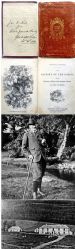
John (Stewart) rose to the rank of Captain in the 53rd Regiment, and retired on half-pay. He was called the oichear mor, the big officer, from his great size. It was said he bad no equal in Strathspey for strength. There are two boulders that lie near the gate of Achernack, Clachan neart, which were used as tests of strength. One man out of ten might lift the smaller over the dyke, but not one in a thousand could do this with the other. The big officer could toss them both over, one after the other, with ease”
From “In the shadow of Cairngorm” by the Rev W Forsyth and published in 1900 by The Northern Counties Publishing Company.
Instantly it should be seen that the published work clearly alludes to the fact the stones were still in pace in 1900. Further texts on these two stones repeat the affirmation of the strength of John Stewart and the fact that both stones were used as traditional tests of strength, but they also pinpoint the location of the stones to the gatehouse at Auchernach. The reference to both stones calls them “Clachan neart” and again it should be emphasised that these were no putting stones. There is more than a hint that as the stones were required to be thrown over a dyke wall and not placed on top, that the actions of John Stewart was an emphasis of superior strength. The lifting and throwing over a recognised plinth is not a unique style as it is also replicated with the Wallace Putting Stone and also the possibility of the same style being applied to the Puterach at Balquhidder as inferred by its name. The Barevan Stone, as much a clone of the celebrated Inver Stone as one could imagine was also known as Clach Neart – the Putting Stone of the Clans and in addition to this, the Clach Neart of Strathmore of Durness is again a heavy stone, a lifting stone that was also expected to be thrown. The inclusion of these stones of Auchernach only cement the strong evidence that the Clach Neart was not simply a putting stone as used in today’s modern Highland Games but strengthens the argument that such stones were so named only because they were expected to be thrown, regardless of actual weight.
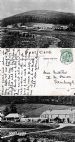
Photographs of the Gatehouse at Auchernach circa 1971 and as it is today Clearly both stones were located at the Gatehouse of Auchernach Estate and as the photograph above shows, there are two stones resting at the west side of the house. Whether these are the two stones that are referred to in the text cannot be confirmed however one of the stones shown was known to have been moved to prevent it causing an obstruction to estate vehicles and still exists. Known as a horse mounting block, this large rectangular slab of Cairngorm granite was known to have been located at the Gatehouse to assist in the mounting and dismounting of horses in days before motorised transport. These types of stones exist all over the British Isles and in Scotland in particular they are known as loupin stanes in Scots. These stones take various forms, some are single slabs and some take the form of simple stairs but chiefly they are located where hoses were expected to be mounted or dismounted such as Churches, Inns or as in this particular case, a Gate House.
Not discounting the fact that there is evidence that exists to suggest that such stones were indeed used as testing of strength, nor indeed the reasonable assumption that on many occasions, the most obvious example being the Dinnie Steens, that there was a dual purpose of some lifting stones. Be it an anchor weight for scaffolding or indeed a stone for tethering a horse, it would not be beyond the imagination to suggest that such a mounting stone could have a dual purpose which would include that of strength. There is nothing of course to confirm the existing louping stone is in fact one of the traditional stones of strength that were situated at the Gate House and although what chance would there be for the three stones, the two stones and louping stone to exist side by side the reality is this would cause a great deal of confusion let alone take up a great deal of space. The evidence then suggests that the loupin stone is in all probability one of these ancients testing stones however the evidence is purely speculative and without either a descriptional account or verbal confirmation from a credible source that the stone is such, then sadly its position will be unconfirmed and must remain that way. The second stone may still exist as a large stone, now covered in moss and grass lies to the west of the Gatehouse partially submerged in a steep embankment. Again, without firm evidence to suggest otherwise there cannot be any confirmation that this stone, indeed the larger of the two and far more rounded, is the heavier second stone. Pure speculation on the history would point to both stones being mounting stones situated at the Gate House but also both being used as tests of strength. From the written account, the lighter of the two stones, the existing mounting stone could possibly be lifted by “one man in ten”. The odds of one man in a thousand for the larger stone may well be considered as slightly understating its weight. The existing stone, be it authentic or not sits due east of the south lodge (house opposite the north lodge as shown in the photographs) however the current owners are fully aware of the historical significance of the stone as a mounting stone and not as a lifting stone and would prefer this to remain so unless firm evidence to the contrary is discovered.
Picture added on 10 March 2021 at 21:07
This picture is in the following groups
estate
estate
estate