The Glenbuchat Image Library
No: 2256 Contributor: No Contributor Year: 2020
3 Dalphuil


Dalphuil/ Dalfail
Introduction to Farquharson Family Story
Click for Farquharson Album
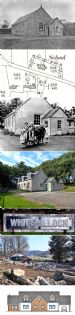
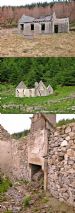
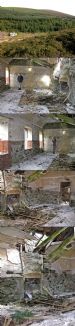
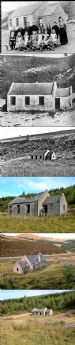
Picture above shows:
1. Map showing distance between Faichla and Dalphuil
2. 1850 Map of Glengairn
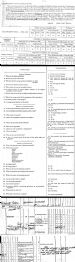
3&4 Name Book entry for Dalphuil 1865
5 Dalphuil School today
6 Mr Coutts Schoolteacher and family
In the 1861 census John Farquharson is still at Faichla but by 1871 he is staying at Dalferil. He is staying with a James Coutts and family.
On checking James Coutts’s Census records, in 1861 he is at Dalfail School House and his occupation is Schoolmaster. In the 1871 Census the address is spelt Dalferil. This is a common problem in census information. Local worthies who could read and write e.g. the Schoolmaster or Minister and went round recording names and addresses. As most of the locals could not read and write the recorded made up a spelling from the sound of the name which may vary from person to person.
Dalphuil Dail phuill, "field or haugh of the bog or pool."
On closer checking the proper spelling of the name is Dalphuil School house and the building still exists.
It is interesting to note that in the two census’s 1861 and 1871 the following members of theFarquharson family are at the school
John Farquharson
Alexr Farquharson
Charlotte Farquharson
Donald Farquharson
William Farquharson
1861 Scotland Census
Name John Farquharson
Age 3 Estimated Birth Year abt 1858
Relationship Son
Father's Name Robert Farquharson
Mother's Name Hellen Farquharson
Gender Male
Where born Tarland, Aberdeenshire
Registration district Tarland
Civil parish Tarland County Aberdeenshire
Address Faichla
Household Members
Robert Farquharson Age 48
Hellen Farquharson Age 38
Elisabeth Farquharson Age 10
Alexr Farquharson Age 8
Robert Farquharson Age 5
John Farquharson Age 3
Charlote F Farquharson Age 1
1871 Scotland Census
Name John Farquharson
Age 13 Estimated Birth Year abt 1858
Relationship Boarder
Gender Male
Where born Strathdon, Aberdeenshire
Registration district Glenmuick
Civil parish Glenmuick
County Aberdeenshire
Address Dalferil
Occupation Scholar
Household Members
James Coutts Age 47
Margaret Coutts Age 53
Hellen Coutts Age 18
Jane Coutts Age 17
William Coutts Age 13
Mary Coutts Age 11
Catherine C Coutts Age 9
Jemima Coutts Age 3
John Farquharson Age 13
Alexr Farquharson Age 13
Charlotte Farquharson Age 11
The 1865 OS Aberdeenshire name book records:
SCHOOL (Dalphuil) (Partly Endowed)
Recorded by: Mr Coutts, Schoolmaster Mr McIntosh Revd [Reverend] Mr Neil
Report: This school is under the same roof as the schoolmaster's dwelling house, both of which, together with the office houses, are Known by the name Dalphuil. There is an average daily attendance of scholars of about forty. Supported by the interest of money left by a lady now deceased (Not a Parish School).
In 1841, the census of that year records that Donald McKenzie, aged 28, married with family, was the schoolmaster at Dalphuil, whilst James Coutts, grandfather of the younger James Coutts, aged 55, was listed as a teacher residing at Bridgend of Gairn.
The 1851 census lists James Coutts, younger, aged 28, married with a young family, as the schoolmaster at Dalphuil. ' According to Neil, the school was then attended by fully sixty scholars, "well taught by Mr. Coutts, at least as far as the three-R's were concerned". From this observation it can be assumed that by the middle: of the nineteenth century, the dramatic yet protracted depopulation of Glen Gairn had not yet commenced. Coutts was still resident at the Glen Gairn schoolhouse in 1881 but by then described hams as retired.
School Boards introduced with the passing of the Education Act of 1872;
thee Glen Gairn School Board, notes Smith, was constituted with five members and the one school, located at Dalphuil, had 37 pupils on its roll, and "Bible" was listed as a subject on the curriculum. At the 1871 census, the Glen Gairn population, with all denominations included, stood at 600.
In the Statistical account for Glengairn there was a report about the school:
“A Mrs Elizabeth Farquharson, late of Jamaica, and a native of the parish of Tulloch, bequested at her death, which happened between 20 and 30 years since, £400 sterling for the benefit of the poor here, and the like sum to keep a school and schoolmaster in these Parishes. There were four trustees appointed to execute this part of her will: but somehow or another it was neglected for upwards of 20 years, when at last one of the trustees who had friends in Jamaica, recovered the £4-00 principal and £200 of interest; and the £600 have now been in the bank at Aberdeen for several years. It surely could not have been the intention of the testator, that the money should be so long in being applied to the purposes it was designed for.”
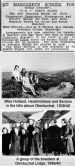
A newspaper report of Tuesday 18 September 1888
THE FARQUHARSON EDUCATIONAL TRUST.
NEW SCHEME OF ADMINISTRATION.
Approval has just been given to a scheme, known the Farquharson School Bursaries, hitherto held and administered under deed of mortification by John Farquharson of Invercauld, dated 25th April, 1732, and further deed of mortification, dated 30th May, 1804; the Macdonald and Farquharson Bursaries
The Farquharson Educational Trust
New Scheme of Administration
Approval has just been given to a scheme, under the Educational Endowment: (Scotland) Act 1882, for administration of the endowments known as The Farquharson School Bursaries, hitherto held under deed of mortification by John Farquharson of Invercauld, dated 25th April. 1732 and a further deed of mortification, dated 30th May 1804: the Macdonald and Farquharson bursaries held and administered for educational purposes by the proprietor of Invercauld; and the Jamaica endowment, presently held and administered under the last will and testament of Miss Elizabeth Farquharson dated 23th March, I767. The free income these endowments (now a to be henceforth administered by a governing body incorporated by the name of the Farquharson Educational Trust) is to be applied in the following manner:
The governors shall apply an annual sum in establishing a school bursary, to be called the Farquharson Bursary, of the yearly value of not less than £5 nor more than £10. This bursary shall be awarded by competitive examination among pupils attending public or State-aided in the parishes of Tullich, Glenmuick, and Glengairn who have passed the Fifth Standard of the present Scotch Code, or such standard an may from time to time be fixed by the Scotch Education Department, pursuant to the Education (Scotland) Acts, as that entitling children to total exemption from the obligation to attend and whose parents or guardians arc in such circumstances as to require aid for giving them higher education; these bursaries shall be tenable for two years at public or State- aided schools in which efficient instruction is given in the higher branches.
More research on Miss Farquharson revealed the following information:
A branch of the Farquharsons were designed “ of White house ;" and from the Groddies being formed part of the estate, Miss Elizabeth Farquharson of Jamaica (known as Black Bess), when she willed that the interest of £400 (now £700 in consequence of the legacy not having been realised for many years) should, in all time coming, be applied to the support of a school at Glengairn and to aid the most necessitous poor of the united parishes of Tulloch, Glen Muick and Glengairn, included the poor upon the lands of Old and New Groddie. (Information kindly communicated by the Rev. Mr Michie, parochial schoolmaster.
Black Bess was sister to Harry of Whitehouse who fell at Culloden; and the name of “Whitehouse” was carried to a property in Tough (previously Abercattie) by Mr Farquharson, an Aberdeen advocate, father of the present laird, whose grandfather was a medical practitioner in Dundee. The doctor's father, who was of the old stock of the Farquharsons, was a captain in his chief's regiment at Culloden, where he fell, along with his kinsman of Auchriaolian.
There is no direct relationship between Miss Elizabeth Farquharson and the Farquharson of Faichla. However, going further back there may be a connection as many Strathdon Farquharsons are related to the Farquharsons of Invercauld.
Another matter for comment which relates to these bursaries is that the money gained by the Farquharsons in Jamaica was on the back of using slave labour on the plantations
From an Article in the Guardian by Stephen McLaren:
Eighteen months ago, I was photographing the slave auction site Farquharson Wharf in Black River, Jamaica, where the Zong’s survivors passed from being cargo to human livestock for an average of £35 each. For those Scots – and there are many of us – who have been unaware of our own nation’s culpability in this ghastly business, the revelation that Farquharson Wharf was a Scottish-owned business, and that many of the souls who passed though its doors would go on to toil in the numerous Scots-owned sugar plantations in the surrounding countryside, should give pause for shame and reflection.
In contract to the wretched life of the slaves the following describes life near the plantation:
In the late 19th Century, due to the export of Logwood, Black River became one of the richest towns in Jamaica, and it was actually the first town in Jamaica to have electricity. The Farquharson and Leyden families, who had two beautiful Victorian mansions at Black River, Invercauld and Magdala, competed with each other to entertain in the grandest manner. Mrs. Leyden, who had once been an Opera singer in Paris, was the leading Society hostess of Black River during the Victorian era. Old St. Elizabeth families such as the Farquharsons, the Griffiths, the Dalys, the Robertsons, the Hendricks, the Levys, the Cuffs, the Earles, the Calders, the Muirheads, the Myers, the Brownes, the Muschetts and the Coopers, would have been frequent guests at her mansion, to listen to visiting Opera singers, Orchestras and Classical Pianists. A fashionable Spa at Black River attracted International Society including British aristocrats, titled Europeans and even the King and Queen of Belgium. One of the first Motor-Cars in Jamaica was imported into Black River in 1904 by the Griffith family of Hodges Pen and, after the First World War, came the "Dance of the Millions" in the 1920s with new Rolls Royces, free-flowing Champagne and endless Cocktail Parties.
Another question is why the Farquharson Children went to a school 10 miles away from their home and not to the one at Strathdon. The school was stated to be for the children of the local lairds. The major land owners, the aristocracy, sent their sons to Eton and Harrow in England to Dalphuil must have been for the families of lesser landowners and farmers.
It would appear that the bursaries arrived about 1881 therefore would not have benefitted the Farquharson children. Another factor might be that Robert Farquharson, their father was the Land Stewart for the local estate there might have had some disagreement with the local tenants and therefore have problems at the local school.
Finally, and possibly more likely, was the fact that Glengairn was a strong Catholic area in Strathdon along with Corgarff. While the school was not catholic there was specific Catholic teaching for catholic pupils as shown in the following letter to the newspapers.
To the Editor of the Aberdeen Journal. SIR,
In the report of a meeting of the School Board of Glengairn, stated to have been held on the previous Saturday, contained in your last issue, is the following : A good deal of discussion followed as the time table to used, a difficulty arising on the religious element, from the fact that the public school of Glengairn is attended also by the Roman Catholic children. It was ultimately agreed, on the motion of the Roman Catholic member, that no Catechism should be taught in the school, and that religious teaching should extend to the use of the Bible only, and in the event of the Protestant Catechism being taught, the Roman Catholic Catechism should also be used in the school. From this the Rev. R. Neil dissented.” parties perhaps better deserving of being mentioned than I are not named in the above, beg, for the sake of modest merit, to give a rather fuller account of the matter. I moved That the Teacher devote half-an-hour each day, immediately after opening, to religious instruction according to use and wont; and that it shall be competent for those who cannot conscientiously avail themselves of the whole or any part of it, to absent themselves, or to appoint one of their number, or any other person, to communicate instruction according to the tenets ot their Church at the same time, in some part of the school buildings. It will thus be seen that I did not object to the introduction of the Roman Catholic Catechism. I merely contemplated its being taught by some one who believed its doctrines, and I thought that this would not be a very unfair way of settling the religious difficulty to a sect which I believed formed only about a sixth of the population of the whole parish, and paid about a tenth of its rental. It was, however, characterised by the Chairman as tyrannical motion. Mr D. Mackintosh. H.C., agreed to allow the use of the Protestant Catechism in addition to the Bible, provided the teacher, member of the Established Church, taught the Roman Catholic Catechism also. Against the latter part I remonstrated, and pleaded that the conscience clause should be extended to teachers as well as to scholars. Mr T. Gillanders seconded Mr Mackintosh’s motion, which the Board declared carried. This took place on 18th October, not on last Saturday. By inserting the above in the Journal, you will oblige, Yours faithfully, ROBERT NEIL. Manse of Glengairn, 26th December, 1873.
Aberdeen Press and Journal - Wednesday 31 December 1873
Finally, there remains the matter of Dalphuil Royal Connections.
Dalphuil as part of Glengairn has a number of Royal connections over a number of generations.
The area changed dramatically when Queen Victoria and Prince Albert bought Balmoral Castle in 1858. Balmoral is only 10 miles from Glengairn. They spent a lot of time in the area and after Prince Albert’s death in 1861 Queen Victoria spent a great deal of the next 20 years at Balmoral Queen Victoria therefor made regular drives in the area
Amy Stewart, the daughter of the minister wrote in her book ‘The Hills of Home’.
“At the age of five she was taken to a vantage point high among the pines at Flt o' Gairn to see the Queen drive past, a little old lady ln a black bonnet and dolman ( a woman's wrap like a cape in vogue in the 19th century with wide sleeves cut in one piece ). All along the road groups of people gathered to wave to her as she went by slitting very erect, bowing in her serious, formal way,
On one occasion the Glengairn Manse family were at Rinloan when the Castle menservants arrived to prepare a picnic tea on the grassy stretch in front of the house closely followed by the children.
“Concealed behind lace curtains we observed them at play, frolicking in perfect freedom. Little Prince John was alive then and I chuckle when I remember how the eldest boy (the Duke of Windsor) put his little brother across his knee in mock severity, and brandishing the sticky circle from a jam-pot; called in glee to the others, ‘Watch me rub John's face with strawberry jam!’ But John's big sister came to the rescue."
On another occasion Mrs Fraser attended a Grand Bazaar with her parents. and was given half-a-crown to spend
"The young Princes Henry and George (the Duke of Gloucester and the Duke of Kent) were therein their kilts, and I was detailed to sell them post-cards. Then I decided to buy for my mother a bottle of scent which I saw on a stall, priced one shilling. I tendered mu half crown and received my bottle of scent. ‘No Change’ said the smiling, Eton collared young Duke, who was the salesman.
So, there I was. With no money to spend, and to add to my discomfiture, the stopper came out of the bottle and drenched my velvet Dorothy bag. It must have been a good scent, however, for the fragrance lingered for months. “
The present Queens Mother was a keen picnicker at Balmoral and had favourite spots to go. One was a cottage at Auchtervan near Balmoral which was becoming a ruin and she bought it and restored it.
In 1950, as Dalphuil was in danger of becoming a ruin it was bought by King George 6th for his wife. The building, which contains five rooms, is to be used for shooting parties and as a retreat for the Queen and the two Princesses. On her death HRH The Queen Mother bequeathed the building to her grandson Prince Charles.
Perhaps this proximity of Royalty and Nobility enabled young John Farquharson to develop the skills needed to become a butler in aristocratic houses.
The following chapter highlights another royal connection and possible scandal.
 View Large Version
Picture added on 27 April 2020 at 22:16
This picture is in the following groups
school
school
My family came from this area
Added by George Coutts Simpson on 30 July 2023
James Coutts was my great great grandfather, his granddaughter, Helen will be the young girl at the front, she was married in Perthshire and moved to Roslin and lived in a house which they named Gairnside, my grandmother lived with her after her husband, Brunton Smith was killed in action in France in 1918.
Added by Brunton Hunter on 24 December 2023
school